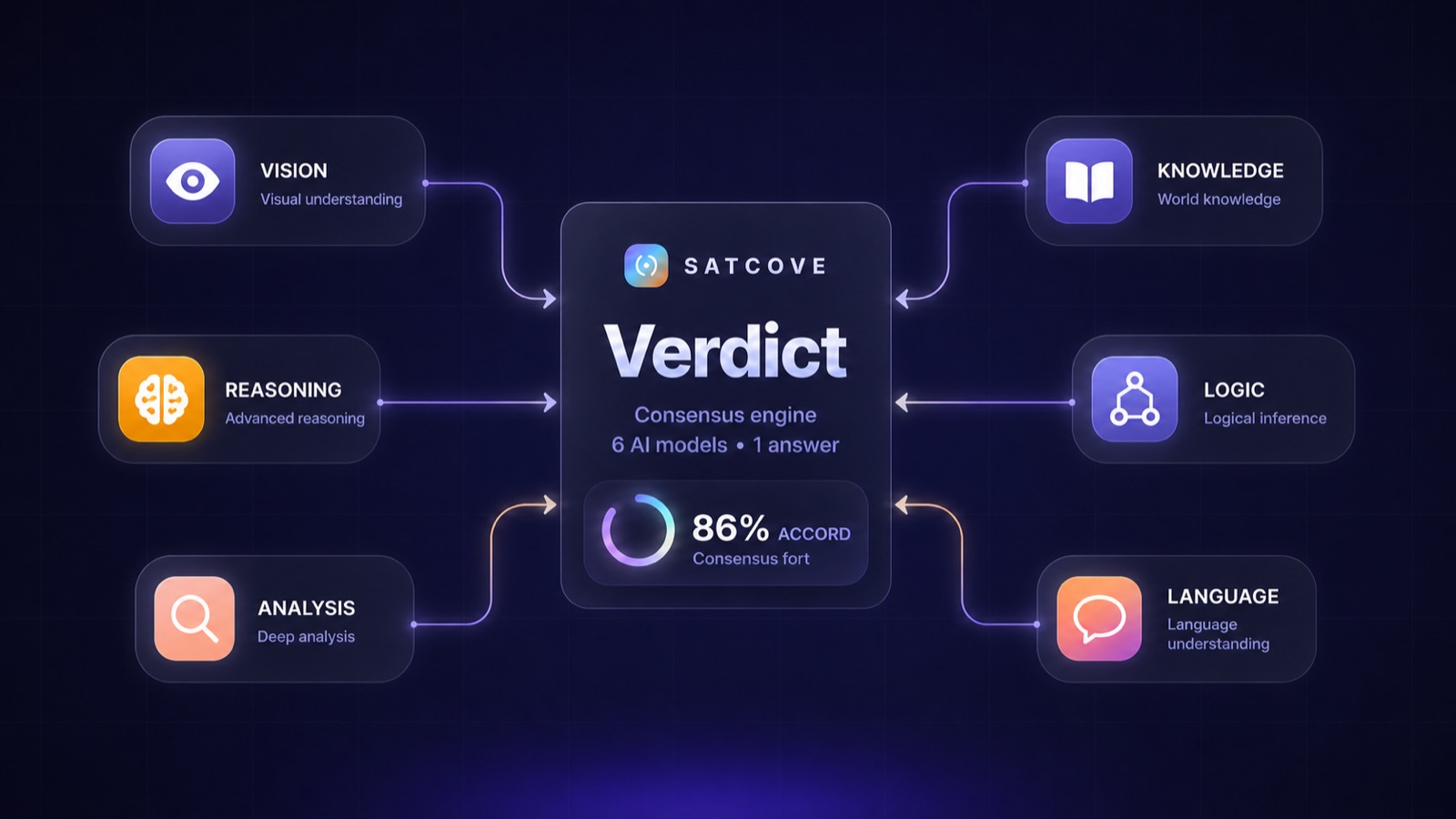
Quick answer: A consensus engine queries multiple large language models independently on the same question, compares their conclusions, and synthesizes one verdict with a visible agreement signal. Unlike an aggregator, it does not leave the user with several raw answers to reconcile. Unlike a router, it does not silently select a single model. Agreement describes panel alignment, not guaranteed truth.
What Is a Consensus Engine?
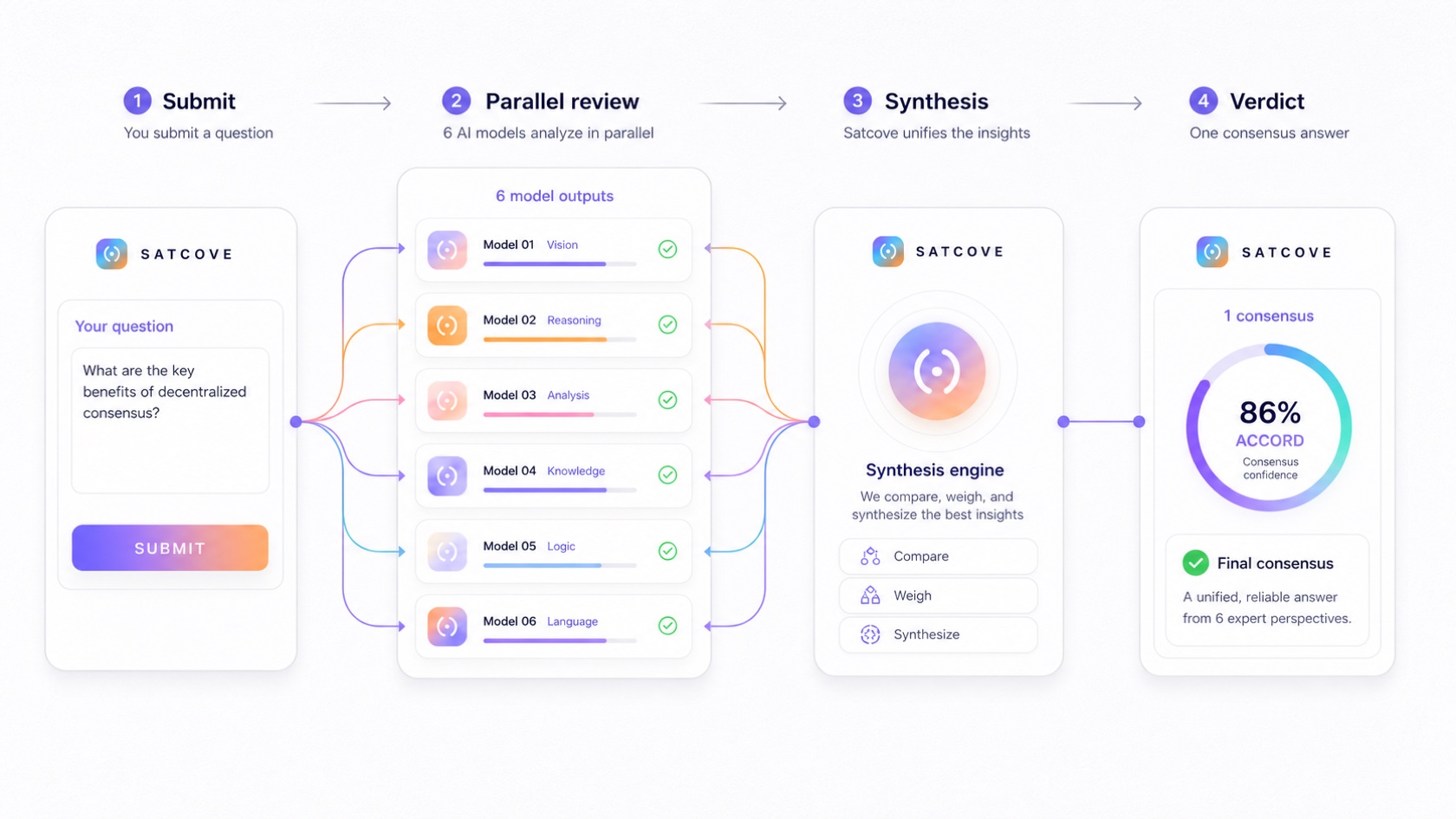
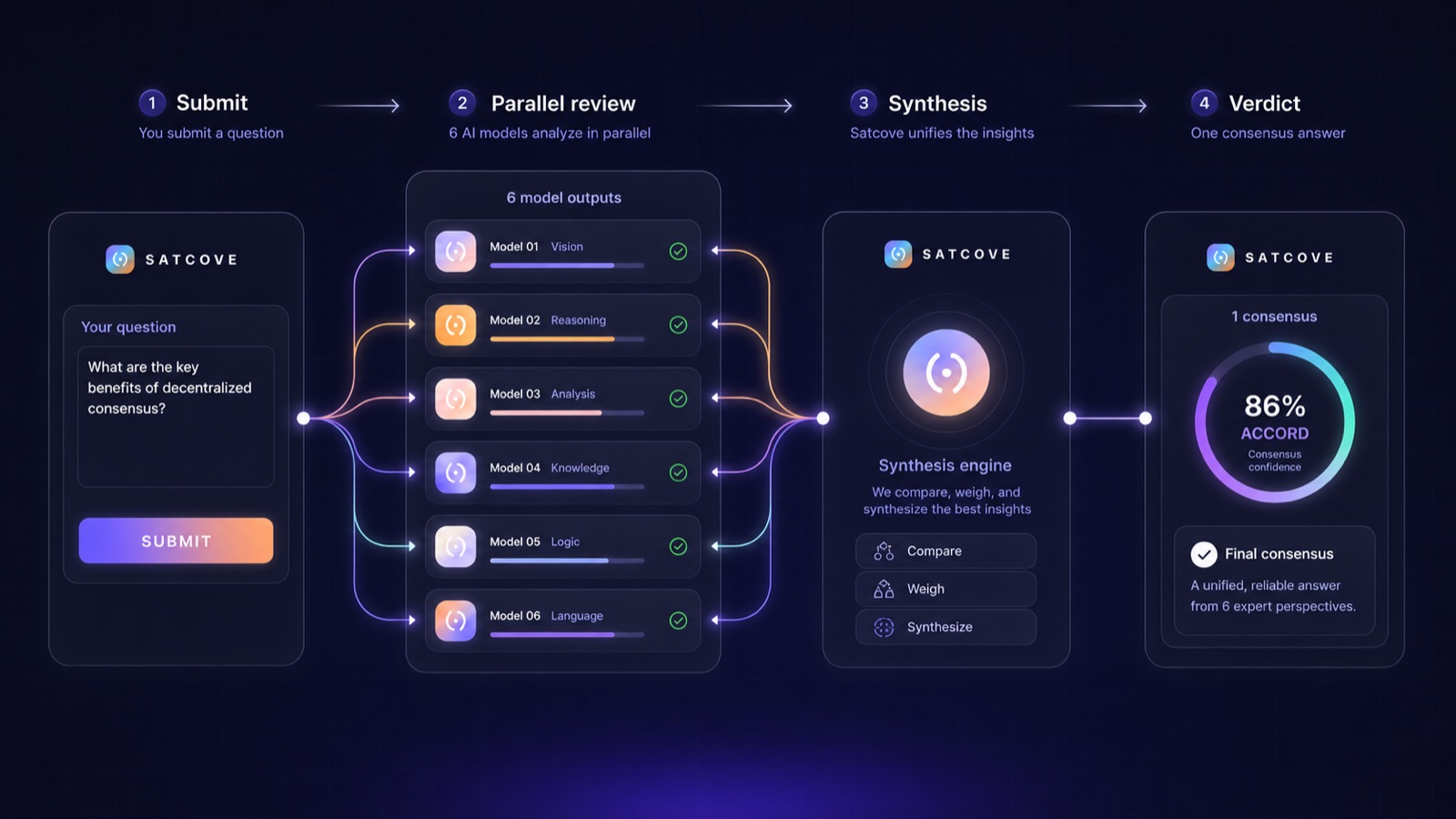
A consensus engine is a system architecture, not a single product. The defining property is that it queries multiple independent AI models on the same input, then combines their outputs into a single, calibrated answer.
The word "consensus" carries a precise meaning here: it is the measure of agreement across the models, not just the fact of running multiple of them. A consensus engine surfaces:
- Where the models converge — the points all or most models agreed on, which deserve a shared-position label rather than an automatic truth label.
- Where they diverge — the points of substantive disagreement, which mark genuine uncertainty.
- An overall agreement score — a quantitative summary of how aligned the answers were.
- A synthesized verdict — one combined answer faithful to the inputs.
Read the dedicated consensus engine page for the product-level explanation, or the benchmark methodology for the measurement details.
Where Does the Idea Come From?
The architectural ancestor is ensemble learning, a 1990s machine learning technique. Random forests are the classic example: instead of trusting one decision tree, you train many trees on different random subsets of the data and average their predictions. The averaged prediction is consistently more accurate than any individual tree because the errors of independent trees do not correlate perfectly.
The same broad intuition can help with large language models, with an important limit: model errors are not fully independent. Systems can share training material, popular misconceptions and the same missing context. Multiple answers are useful because they expose alignment and divergence; primary evidence is still needed to decide whether a factual claim is correct.
The shift from research to consumer product is what changed in 2025–2026. Consensus engines are now reachable as iOS apps and web tools, not just research papers.
Consensus Engine vs Aggregator vs Router
Three categories of multi-model AI tool exist in 2026. They are easily confused.
Aggregator
Shows you the raw outputs from multiple models side by side. You pick. Examples: AI Fiesta, ChatHub, MultipleChat.
Strength: Lets you see each model's thinking directly. Weakness: You still have to do the comparison and synthesis yourself.
Router
Picks one model per task on your behalf. The decision is made by an algorithmic meta-layer based on the question type. Examples: TypingMind plugins, some Magai modes.
Strength: Faster than running everything in parallel. Weakness: You only get one perspective, chosen by the tool — the single-model failure mode is back.
Consensus engine
Runs all the models in parallel and synthesizes their outputs into one verdict with an agreement score. Example: Satcove.
Strength: One synthesized answer plus an explicit confidence interval. The disagreement signal itself is surfaced. Weakness: Slower than a router (all six models must respond), more expensive than a single API call.
The choice between these three depends on what job you are trying to do. If you want raw outputs to compare, an aggregator. If you want speed at the cost of single-perspective risk, a router. If you want a decision-grade verdict with quantitative confidence, a consensus engine.
How Does Synthesis Actually Work?
The synthesis layer is the hard part of a consensus engine. The naive implementation — concatenate all six answers and call it done — is just an aggregator. Real synthesis means producing one new answer that is faithful to the six inputs while extracting the signal across them.
Satcove's synthesis pipeline:
- The six provider responses arrive (typically 8–15 seconds after the query).
- A synthesis model (Claude Sonnet or GPT-5 depending on plan tier) is prompted with the raw outputs and explicit instructions to not invent facts, not paper over disagreement, and use the agreement score to calibrate confidence in the verdict.
- A separate signal computes the agreement score from semantic similarity (embedding-based) plus structural direction (do the six conclusions point the same way?).
- The synthesized verdict and agreement score are returned together, along with the per-model raw responses if you want to inspect them.
The faithfulness constraint is what separates a real consensus engine from a confident-sounding monologue dressed in multi-model clothes.
What Is the Agreement Score?
The agreement score summarizes how strongly the independent responses align. It considers whether the models reach the same conclusion, not merely whether they use similar words.
| Panel pattern | What it tells you | What it does not tell you |
|---|---|---|
| Strong alignment | The models share a conclusion | That the conclusion is proven |
| Partial alignment | The conclusion is similar but assumptions or details differ | Which detail is automatically correct |
| Material split | At least one disagreement can change the decision | That the majority should win |
Read the score alongside the written divergences and the available evidence. The dedicated guide explains how an AI agreement score should be interpreted, and why consensus is not a majority vote.
Why Does a Consensus Engine Matter for AI Safety?
The most dangerous failure mode of single-model AI is confident hallucination. The model produces a plausible-looking answer that happens to be wrong, with the same tone and formatting as when it is right. The user has no signal to discriminate.
A consensus engine makes this failure easier to inspect. The models may disagree when one system hallucinates, but they can also repeat the same wrong premise. The disagreement is a signal to investigate; agreement is a signal to inspect, not permission to skip verification.
For decisions where being wrong has real cost — medical, legal, financial — that signal is the difference between informed and overconfident. Read the AI fact-checking benchmark for empirical examples of where this matters.
Are There Other Consensus Engines?
Yes, of varying maturity and scope. Tools to be aware of in 2026:
- Satcove — consumer-grade, six models, native iOS, multilingual output, vertical features.
- ConsensusEngine.io — research-style adversarial consensus with anonymous voting. Closer to a research instrument than a daily tool. Comparison.
- Tryverdict — direct positioning competitor, earlier-stage product. Comparison.
- Consensus.app — different category — it is an AI search engine over peer-reviewed scientific literature. The word "consensus" refers to scientific consensus across published papers, not multi-LLM synthesis.
- Academic projects (e.g. Building an Adversarial Consensus Engine from SentinelOne Labs, March 2026) — research papers and prototypes for security applications.
Each of these makes different design trade-offs. The right one depends on whether you want a consumer product, a research instrument, an academic literature search, or a security analysis tool.
Why Has Consensus Become Important Now?
Three trends converged in 2025–2026:
- Model quality plateau on benchmarks, divergence on real questions. All major models score well on standardized benchmarks. Their answers to your specific question still differ wildly. Consumers noticed.
- Hallucination tolerance dropped. As AI moved from novelty to daily-use tool, the cost of confident but unsupported answers became visible. Users increasingly need a workflow that exposes uncertainty instead of hiding it behind fluent prose.
- API economics made cross-model queries cheap. Six API calls in parallel cost a few cents. Two years ago, the rate-limit math made this prohibitive at consumer scale. In 2026 it is routine.
The result is that the consensus-engine category became viable as a consumer product class. Satcove, Tryverdict, and ConsensusEngine.io are the early entrants. More will follow.
Try a Consensus Engine
The fastest way to see the value of a consensus engine is to ask one a question you actually care about — one where being wrong would matter. Health, legal, financial, technical. Compare its answer (and the agreement score) to what you would have gotten from a single AI.
Satcove's free plan lets you test the workflow across the full model panel. Start with a contested question, then inspect whether the synthesis preserves the strongest disagreement.
Methodology note: agreement measures panel behavior. Factual accuracy still requires relevant evidence or ground truth; see Satcove's benchmark methodology.